

Chantal Akerman
(1950, Belgium)
By Līva Pētersone
Feminist theories, manifested in art, and the name of Chantal Akerman should be synonymous. Alongside Dardenne brothers she is Belgium’s most celebrated film director, and one of the most acclaimed avant-garde film auteurs in the world. Her work is probably best characterized by the famous 1960’s revolutionary slogan “the personal is political”, as it is precisely what interests her in film.
This festival edition’s focus: Woman: a house wife, an avant-garde artist, a prostitute was most probably inspired by Akerman’s most renowned and provocative piece: Jeanne Dielman, 23, Quai du Commerce, 1080 Bruxelles. It is a formal experiment, a political treatise, a feminist manifesto, a silent explosion, and a three and a half hours long test of audience’s patience. Setting new rules in cinema, it is a masterpiece made by someone who was only 25 years of age.
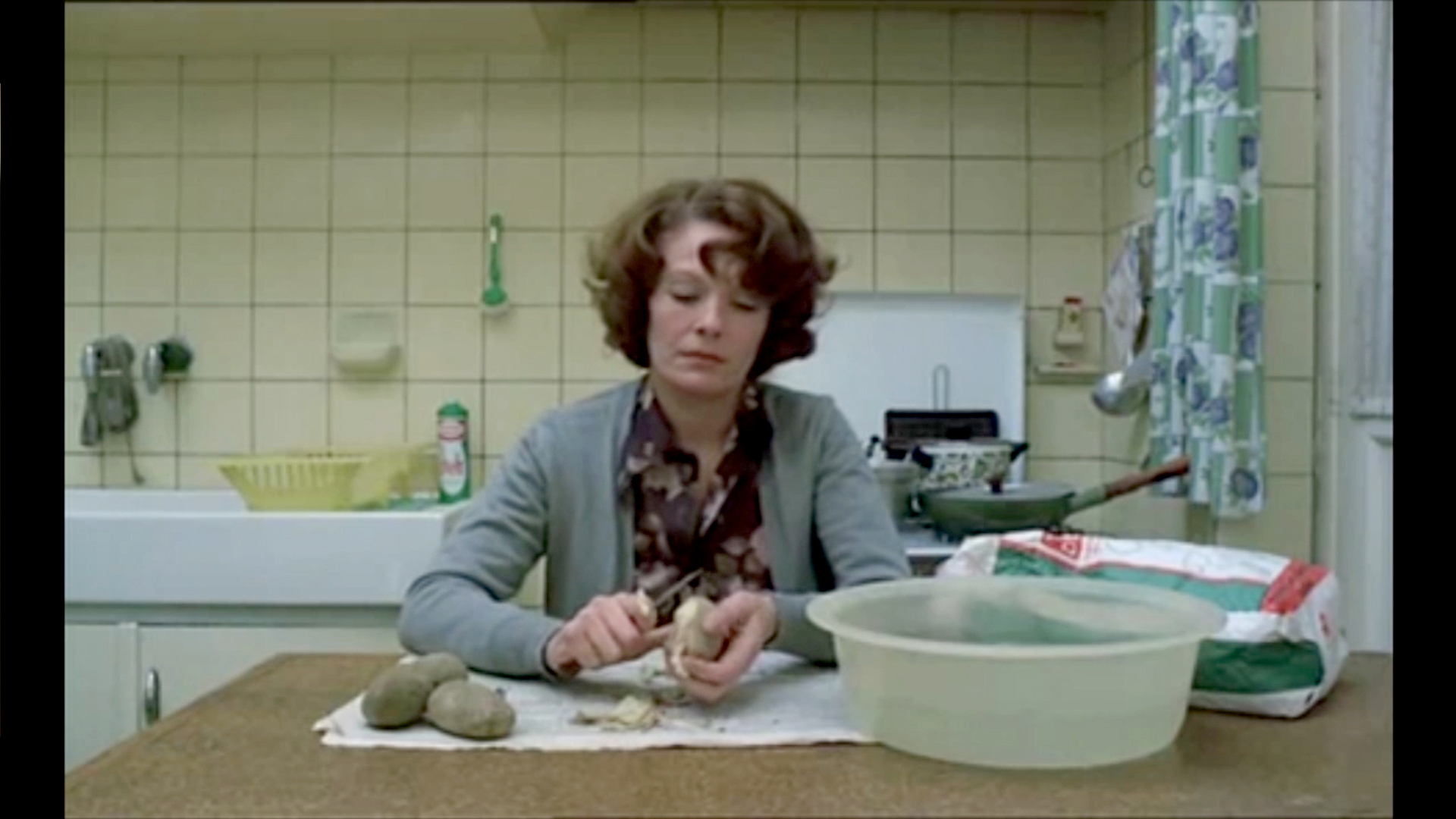
The titular character, Jeanne (Delphine Seyrig), is a Belgian petite bourgeoisie housewife who spends her days peeling potatoes, chopping meat, washing dishes, dusting, polishing her son’s shoes, and... prostituting herself. However, her compulsive-obsessive, controlled actions suddenly begin to unravel and the film steers slowly but inevitably towards its shocking denouement.
The film is a quiet but powerful protest in two ways – as a formal exercise in its aesthetics, and as content in its politics. In form, the director eschews the traditional notions of narrative, her static camera documenting the most petty and boring everyday chores in their real time, making us, the audience, complicit in these, as we come to surmise, absurd actions. And by portraying these little deeds, the film becomes a scathing protest against the patriarchal culture in which a woman not only accepts the role attributed to her, but also incarcerates herself even more by functioning as a non-feeling automaton, serving as a little part in the vast capitalist structure: the eternal homemaker – the eternal servant.
Jeanne Dielman also markedly exhibits Akerman’s influences of other avant-garde masters – Michael Snow, Jonas Mekas, Andy Warhol, alongside parallels with Luis Bunuel’s Belle de Jour. The film is also curiously reminiscent of the cold light and existential solitude infused paintings by Edward Hopper.
The film is a must-see for two reasons – it is one of the most prominent pages in avant-garde film history, and, despite being a testimony to a specific era, its Main Issue is hardly resolved.
Monday, October 21, KSuns, 18:00
Jeanne Dielman, 23, Quai du Commerce, 1080 Bruxelles, 1975, 201', 35 mm